

I work in corporate open source. A specific corner of open source characterized by vendor engagement, foundation partnerships, developer relations for open source projects that have commercial ties. I know this corner well. I think about it constantly. I write about it (apparently a lot, lately).
UN Open Source Week was a reminder of how small that corner is.
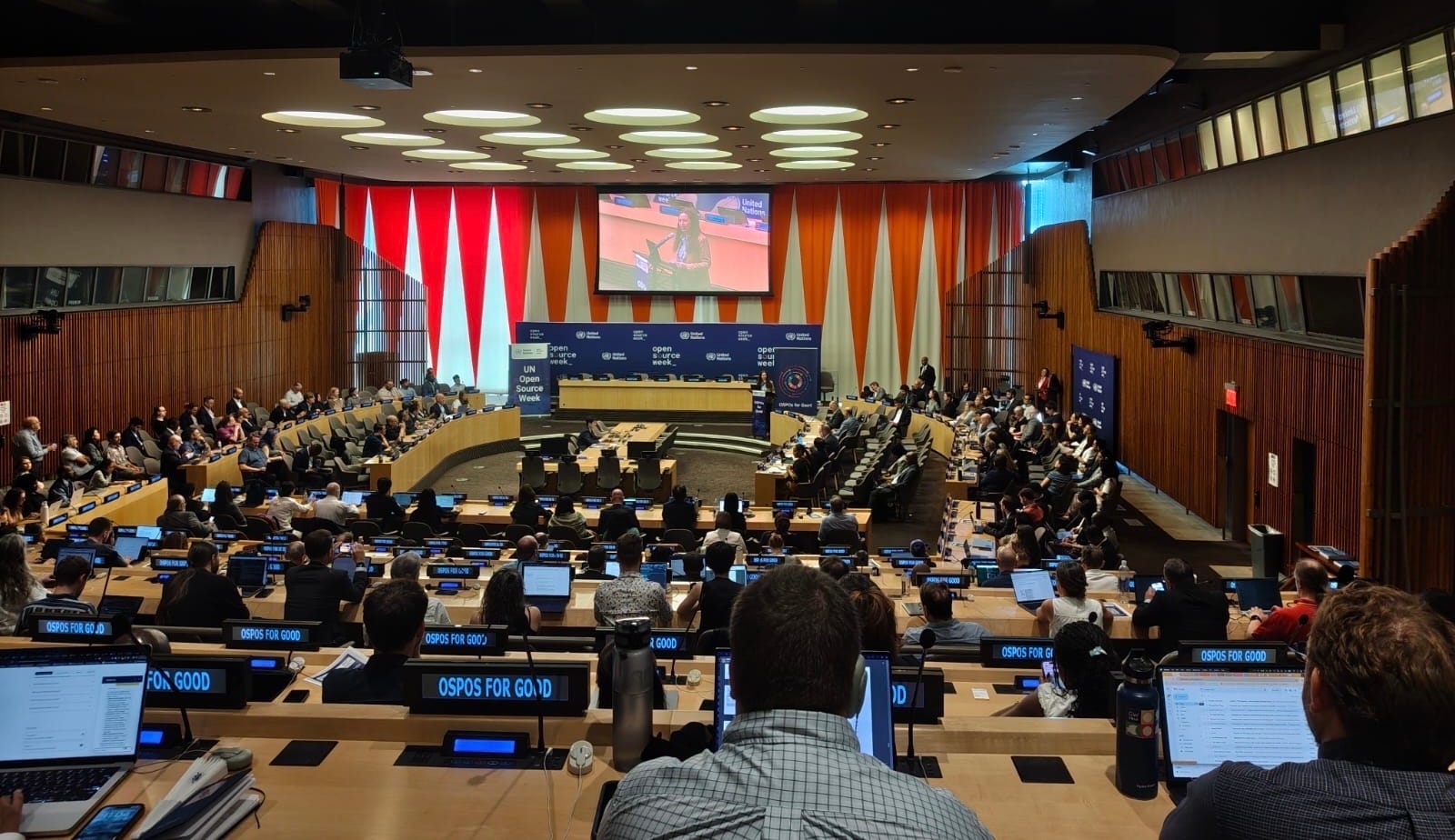
What UN Open Source Week is
The event brings together representatives from governments, international organizations, foundations, and the broader open source community for a week of programming at the United Nations. Each day has a theme—AI, Sustainable Development Goals, OSPOs for Good, and more—and the speakers aren’t your typical conference circuit. They’re policy makers, government technologists, representatives of nation states, people thinking about open source from angles I don’t always encounter in my day-to-day.
Excitingly, this was my first time attending. I was there because my team was given space to host two hours of Women+ in Open Source programming as part of Community Day. That was our contribution. But for the rest of the week, I was just there to absorb.
What I heard
The conversations at UN Open Source Week operate on a different frequency than what I’m used to. In corporate open source, we talk about contributors, adoption metrics, governance models, commercial sustainability. Those things come up at UN Open Source Week, as well, but they were layered underneath conversations I don’t often get a chance to sit in on:
Digital sovereignty. Countries thinking about control over their own technology stacks. What does it mean for a nation to depend on open source infrastructure it doesn’t contribute to? What does it mean to *choose* open source as a matter of policy rather than convenience?
The Cyber Resilience Act. European regulation that’s reshaping how open source projects think about compliance and liability. This is on everyone’s radar in the foundation world, but hearing it discussed from the people writing and enforcing the policy on the government side is a different experience.
Emerging markets and the Global South. How do you build local tech ecosystems when the dominant open source communities are concentrated in North America and Europe? What does contribution look like when the infrastructure, the funding models, and the incentive structures are different?
Sustainable Development Goals. Open source as a tool for public good. Not for commercial advantage or for developer productivity, but for education, healthcare, climate. A motivation for open source I intellectually understand but don’t inhabit day-to-day.
I’m not an expert in any of these. I’m not going to pretend a week of sessions made me one. But sitting in those rooms, hearing what’s top of mind for global leaders in open source absolutely expanded the frame for me.
Where it got personal
The week kicked off on Monday with a Tech Over day which featured smaller, working group-style sessions. I participated in discussion groups on the future of open source (led by Ruth Suehle) and governance at scale (led by Tiffany Farriss), where we dug into topics like sustainability, mentorship, and funding, and how governance models travel across projects.
This was probably the most impactful part of the week for me. Not because of any single insight, but because of the format. We were in small groups with folks from different areas of open source with different perspectives working through the same problems together. And what surprised me was the feedback my team got. Multiple people told us they were glad to hear the corporate perspective—how we think about engagement and why we approach things the way we do. That’s not something I expected. I’m used to being the one learning from the community, not the other way around.
It reinforced something I think is true but easy to forget: the exchange goes both ways. Corporate practitioners have something to contribute to these conversations beyond funding and code. We have context on how decisions get made inside companies—context the rest of the ecosystem often lacks and genuinely wants.
The case for being in the room
I wasn’t at UN Open Source Week to push an agenda. I wasn’t there to promote my company’s open source work or recruit contributors or give a product talk. I was there to learn. To observe. To connect with people who think about open source from a completely different vantage point.
And that matters. Corporate open source practitioners—myself included—can get insular. We optimize for our ecosystem, our projects, our communities. We develop frameworks (guilty) and refine playbooks for our specific context. But open source is bigger than any one company’s engagement model. The problems being discussed at the UN—digital public goods, sovereign infrastructure, inclusive access—are arguably the main reasons open source exists. And they inform the ecosystem we operate in whether we’re paying attention or not.
Being in the room doesn’t require you to have all the answers or even to contribute to the conversation. Sometimes it’s enough to listen. To let the scope of the thing expand in your head. I came away with more questions than takeaways, and I think that’s the point.
Women+ in Open Source
On Friday, as part of Community Day, my team ran a block of Women+ in Open Source programming—a space for women and non-binary contributors and leaders to share their expertise and discuss their experiences in open source.
I opened the block with a lightning talk on corporate open source engagement—essentially a peek inside the black box for an audience of maintainers, foundation leaders, and policymakers who work with corporations but rarely get an honest look at how decisions get made on the inside. It felt like exactly the right audience for that conversation, and I’m planning to expand on it in a future post. Celeste Horgan from my team moderated a panel on the structural levers of inclusive open source engagement—with panelists Divya Mohan, Elaine Wong, Karen Sandler, and Tracy Hinds—and Lahari Chowtoori closed the block with a talk on human leadership in open source AI.
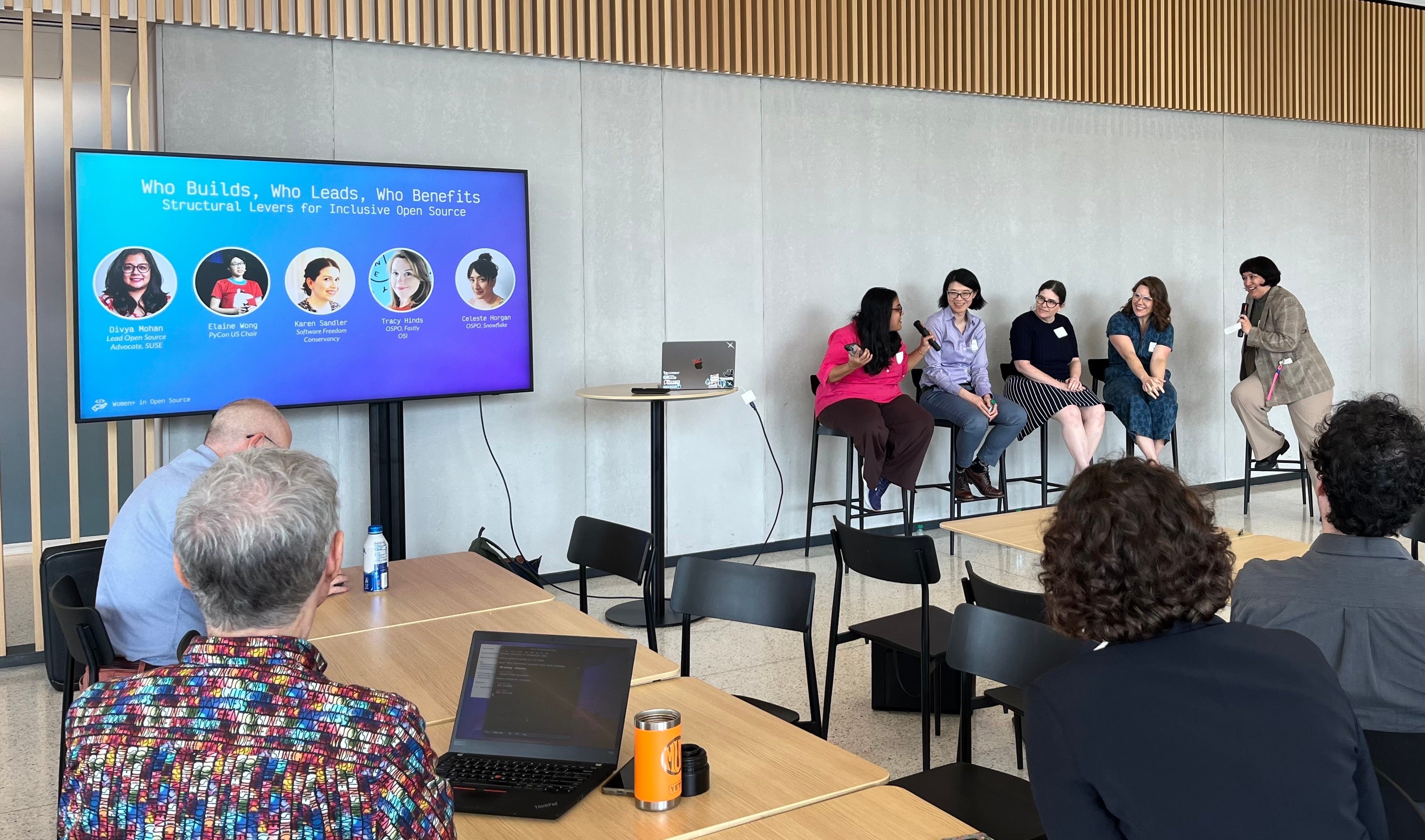
The whole program was admittedly a bit of a last-minute addition to the schedule and wasn’t heavily promoted, but we still got a solid showing. The conversations were rich, the energy in the room was genuine, and the feedback we received was great.
It reinforced something I already believed: when you create the space, people show up.
This connects back to something I wrote about a few weeks ago—the idea that communities are often waiting for someone to create the container. The Women+ program isn’t about fixing a pipeline problem. It’s about making a space that signals “you belong here, and your perspective matters.” That signal works.
What I’m taking back
I don’t have a neat framework to offer here. No four quadrants. No diagnostic model. Just a conviction that got stronger: the corporate OSS world benefits from proximity to the rest of the open source ecosystem. The policy conversations, the global development conversations, the inclusion conversations—they’re not adjacent to our work. They’re upstream of it.
I hope to be back next year. And I’d encourage anyone in corporate open source who has the chance to attend to do so. Not to speak. Not to network. Just to be in the room.
If you’re interested in more writing on open source engagement—how companies show up in communities, what works, what doesn’t, and the occasional reflection like this one—I write about it regularly here. Subscribe if you’d like to follow along.