

The Business archetype is a company that has built or is actively building a commercial offering around an open source project. Their revenue is directly tied to the project’s success. They may have created the project originally, or they may have adopted it and built a product on top. Either way, their livelihood depends on this community.
This is the most complex engagement model of the four. Not because the tactics are more elaborate, but because the stakes are higher and the scrutiny is constant.
The factor profile
Where does the Business sit on the four diagnostic factors?
Commercial dependency: High
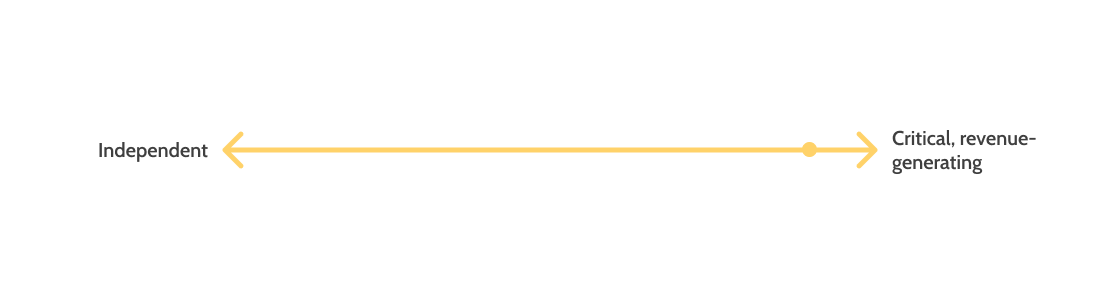
Having a product built directly on top of an open source project means that commercial dependency is high. If this project fails, the business suffers—and probably vice versa. The project’s health is existential in a way it isn’t for the Adopter or the Champion.
Project maturity: Varies
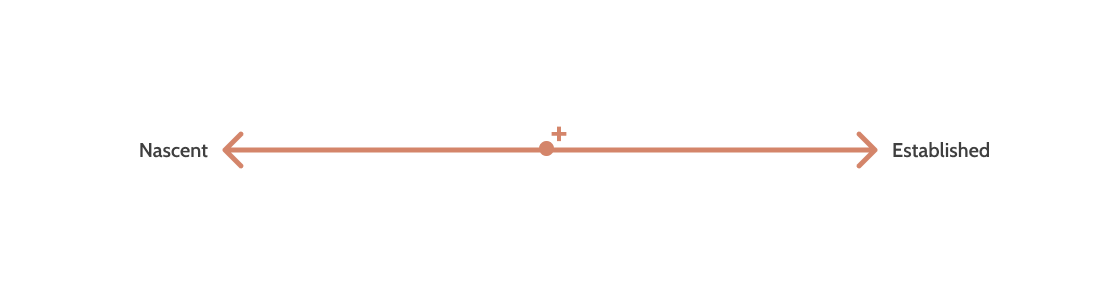
Some businesses are built on well-established projects with large, active communities. Others are building the project and the business simultaneously, which creates its own set of challenges. The former is more common because it’s easier to build a commercial offering around a project that already has proven demand and an existing user base.
Ownership: Variable, but it should be high
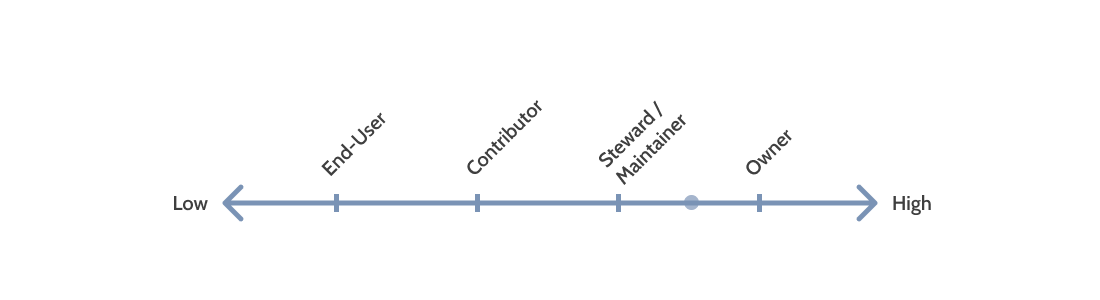
Since the company’s success is tied directly to the project’s health, it’s in their best interest to have meaningful influence over its direction. A business that isn’t engaged in the project’s governance and roadmap risks having the project drift in ways that no longer serve the company’s users or its commercial offering.
As such, the Business archetype will often have the most committers and the most influence over the open source roadmap. In many cases, the founders of the company created the open source project in the first place.
That said, high ownership doesn’t mean total control—and if the Business has the project’s best interests at heart, they shouldn’t want it to. A project that can only survive under the direction of one company isn’t truly self-sustaining—and someone should start asking why the project was open-sourced in the first place. The goal is to strike a balance: enough ownership to ensure the project stays healthy and aligned, while actively creating space for the community to shape its direction and, over time, take on real governance responsibility.
Strategic intent: Product growth
When advocating externally, the Business has an obvious primary goal: leverage the open source project to grow the commercial offering. That goal is hard to hide. The community knows you’re making money from this, and your every move is interpreted through that lens, meaning that the gap between what you say and what you do gets noticed immediately.
But that tension is manageable. Companies in this model can earn genuine community standing when their external advocacy also benefits the project directly—encouraging ecosystem growth, driving adoption that makes the project more sustainable, and demonstrating that the investment in open source isn’t just a top-of-funnel tactic.
Why this is the hardest model
Every archetype requires authenticity. But for the Business, the bar is higher because the incentives are so visible.
When an Adopter talks about a project at a conference, the community assumes they genuinely love it—they’re a user with little to no commercial stake. When a Business does the same thing, the community rightfully asks: what’s the catch?
That’s not unfair. It’s a reasonable response to an obvious reality. The Business is selling something. Their job is to show up in a way that makes that reality feel honest rather than manipulative.
Personal Aside This is an archetype I know from my time at Confluent. Confluent was built around Apache Kafka®—a project that originated at LinkedIn and was commercialized by some of its initial co-creators.
When I joined their Developer Relations team, I was advocating for an open source project while working for the company monetizing it. That tension was real. Not every moment felt balanced. The only thing that worked was transparency—being honest about my role, leading with content that was open source-first, and not pretending the commercial angle didn’t exist.
That experience shaped how I think about the Business model. Done well, it can work. But it requires deliberate, consistent effort to maintain the community’s trust.
Tactics: what the work actually looks like
The Business carries a heavier tactical load than either the Adopter or the Champion. There are bigger expectations on you from all sides—the community, customers, and internally.
Create and support spaces for the community. In order to be trusted, the Business needs to be proactive to support the community. You’re likely the one hosting the meetups, running the community Slack or Discord, organizing the contributor summits. This isn’t optional—it’s part of what the community expects from a company in your position. You have the resources. Use them.
Provide project leadership through your contributions. The Business isn’t just participating in the project, they’re stewarding it. Leading architecture discussions, proposing roadmap direction, reviewing and merging contributions from others—not just your own engineers. At the same time, it’s important that the Business stays on top of project direction in a way that feels balanced rather than self-serving.
Nurture the broader ecosystem. The Business has an incentive to grow the ecosystem around the project, because a healthy ecosystem drives adoption of the commercial offering. This means supporting integrations, encouraging third-party tooling, and perhaps funding community initiatives. A rising tide lifts all boats.
Be transparent about commercial motivations. Don’t pretend the commercial angle doesn’t exist. The community knows. The more honest you are about it—“yes, we have a paid tier, and here’s how it’s different from the open source version”—the more trust you build.
The challenges of monetizing open source
The tension between the open source project and paid offering is central to the Business model, so it’s worth spending time on and explicitly calling it out.
A balancing act
It’s truly a balancing act between maintaining ownership and investing enough in the project, itself.
On one side: if the Business exerts too much ownership over the project—if you control the roadmap, if contributions from others are routinely deprioritized, if governance feels like another hoop to jump through—the project becomes irrelevant to the broader community, and it will start to feel like your company’s thing with an open source label. The community leaves. Forks emerge. You’ve lost the ecosystem that made your business viable.
So companies in this model may deliberately scale back their involvement. However…
On the other side: if they go too far and underinvest in the open source project—if good features remain proprietary, contributions don’t make it upstream, and the open source version feels abandoned—the community turns hostile. You’re seen as extractive.
We’ve seen what happens when companies get this wrong. When the balance tips too far in either direction, the community responds—sometimes by forking, sometimes by abandoning the project, and sometimes by the company making licensing changes that fundamentally alter the relationship with their community.
It’s critical that the Business archetype is aware of this tension. Neither extreme works. The community is always watching where you land.
The funnel question
Now that that’s out of the way, let’s address the actual elephant in the room.
Yes, companies in this model have an open source-to-commercial funnel. Users start with the open source project and some percentage convert to the paid offering. That’s legitimate. In many cases, it’s how the engineers who maintain the project get paid. Without that commercial layer, the open source project often wouldn’t be as well-resourced.
But it has to feel like an optional upgrade, not a bait-and-switch.
Users of the open source project should never feel like they’re being led on—like the free version is deliberately made less effective to force them to pay. The open source project has to be genuinely useful on its own. The commercial offering adds value on top.
Take it or leave it. That’s the right energy. Companies that get this right build sustainable businesses and strong communities simultaneously. Companies that get it wrong lose both.
Measuring success
Metrics-wise, the Business needs to track more than the other archetypes because the risks run in both directions: too little community investment means lost trust, too much control means lost relevance.
CHAOSS metrics for the Business
OSS Project Viability: Strategy. This model assesses a project’s strategic direction and the influence individual organizations have over it:
Elephant Factor. Does one organization dominate the project? If that organization is you—that’s a warning sign. Watch this metric closely. It’s not just about fairness; a project dominated by a single company loses community credibility.
Organizational Influence. How much of the project’s direction is coming from your engineers versus the broader community? Healthy influence is fine. Dominance is not.
Collaboration Development Index. This evaluates how well collaborative development is managed:
Non-employee PR reviews. Are pull requests being reviewed by people outside your company? If only your engineers are reviewing code, you don’t have a community—you have a development team with a public repo.
Contributor trends. Are outside contributions growing or flat? A flat or declining external contributor base while your internal contributors grow is a red flag.
Funding. This examines the financial sustainability of the project and the distribution of sponsored vs. volunteer work:
Contribution Attribution. What’s the ratio of volunteer work to sponsored work (i.e., people paid by companies to contribute)? If it’s 95% your payroll, the community isn’t self-sustaining—and that’s both a business risk and a community health signal.
The key insight: For the Business, these metrics are about balance and warning signals. More often than not, you’re asking “am I too dominant?” rather than “are we growing?”—and that’s a fundamentally different question than what the other archetypes are asking.
Anti-patterns to watch for
Making the open source version feel worse than the paid one. If users regularly feel like the open source version is missing things it should reasonably have, they’ll conclude the project is a lead-generation vehicle, not a genuine community contribution.
Controlling governance in ways that serve the business over the community. If governance decisions consistently favor your commercial interests—features that benefit your paid tier get prioritized, governance meetings are scheduled to reduce external participation—the community will notice and trust will erode.
Measuring your Developer Relations team only by product conversion metrics. Sorry, not sorry. First and foremost, the Business needs to be building credibility in the community, so a part of their Developer Relations strategy needs to dedicated to that goal. If Developer Advocates are only measured by MQLs from conference talks or signups attributed to open source content, they’re going to trend toward product marketing behavior in community contexts, and the community always notices. This is one of the clearest paths to inauthenticity in the Business model. That isn’t to say that the Business can’t care about those metrics, but there is a time and a place—perhaps I’ll write more on that in another series…
Examples in the wild
Confluent + Apache Kafka: As mentioned above.
Databricks + Apache Spark™: Created Spark at UC Berkeley, built a major commercial business around it, and has continued to invest heavily in the project’s open source health.
ClickHouse: Open-sourced the project and built a commercial cloud offering on top of it, navigating the open-core model in a space with high community expectations.
The Business in context
The Business model is the most scrutinized of the four archetypes—and for good reason. When a company’s revenue depends on an open source project, the community has a legitimate interest in watching how that company shows up.
Done well, it’s one of the most powerful models in open source. A well-resourced company with genuine commercial stakes is often the best thing that can happen to an open source project: it brings engineering investment, community infrastructure, and long-term commitment that volunteer-driven projects often can’t sustain on their own.
Done poorly, it poisons the community’s relationship with the project and, eventually, with the company.
The difference comes down to one thing: whether the community believes your investment in the project’s health is genuine, independent of the commercial benefit. That belief isn’t granted. It’s earned—slowly, through consistent action, over time.
Next up: The Founder—what happens when you’re the one who built the project from scratch and is now responsible for growing a community around it from zero. Subscribe so you don’t miss it.