

There’s a default model for addressing representation in open source. You put a panel at a large conference. You title it something about diversity. The panelists share their experiences. The audience nods. Everyone goes back to the sessions they were already planning to attend. Nothing structural changes.
I’ve been a part of those panels. They certainly serve a purpose. And, indeed, they create visibility, which matters. But they operate on the terms of the larger event. You’re a side session. You’re competing with the content people actually came for. The audience self-selects: the people who already care show up and the people who need to hear it don’t. And the format doesn’t leave room for the thing that actually moves the needle—members of underrepresented groups seeing people who look like them doing this work, and connecting with each other regardless of where they are in their open source journey.
The idea
Women, non-binary, and gender-marginalized people (Women+) are already in open source—and that’s the group I want to focus on here. They’re maintaining projects, serving in leadership roles, reviewing code, building community infrastructure. They touch every part of the open source ecosystem. But too often that work isn’t visible beyond their immediate project or we just don’t talk about it. The networks between women across companies, foundations, and experience levels don’t get built by accident—and most conferences aren’t designed to build them.
What’s missing isn’t a pipeline program. It’s visibility for the work already being done. It’s connections between women who are doing similar things in different corners of the ecosystem. And it’s inroads for women who may be curious about open source but don’t yet know the career implications of getting involved or quite see where they fit.
I’m not naïve. I don’t think a single event series fixes the representation problem in open source. But I do think dedicated space does something a diversity panel at a conference can’t: it makes the work visible, it builds the networks, it signals that this is important enough to warrant its own space, and it creates inroads for the next wave of contributors. Not by telling them they’re welcome, but by showing them a room full of people who look like them already doing it.
So earlier this year, we started building that space.
What happens when you create dedicated space
On March 9th, the day after International Women’s Day, we hosted the Women+ in Open Source Day in Menlo Park, CA. A full-day, cross-company event, backed by nearly a dozen sponsors. Over 110 people showed up.
Ruth Suehle, President of the Apache Software Foundation, delivered an incredible keynote. We had a fireside chat on community development and diversity in open source foundations with Ruth, Robin Ginn (Executive Director, OpenJS Foundation), and Stacey Haysler (President, PostgreSQL US)—three women leading some of the most influential foundations in open source, on stage together. Beyond that, we had a panel on the different personas across open source, an AMA with project contributors, five breakout talks, and a hands-on contribution session with mentors.
What surprised us was the breadth of who was in the room. Project maintainers. Foundation leaders. OSPO folks. And people who had never made a contribution but were curious about getting started. So we built programming to serve all of them—content that met people wherever they were on the open source journey.
That range turned out to be the whole point. A first-time contributor sitting next to a foundation board member, having a real conversation—that doesn’t happen at a conference where the diversity panel is a 45-minute slot between lunch and the keynote. It happens when you dedicate an entire day to it. When you design the room for it.
And the energy was different from what I’ve experienced at most tech events. People weren’t just networking. They were connecting over shared experiences and talking openly about the challenges of being underrepresented in communities that pride themselves on being open to everyone.
The most exciting part was that it happened. This small idea to make space to showcase the work that women+ are already doing every day in open source was well-received. That people came. That leaders in open source wanted to be a part of this thing that we thought up—that they saw this as worth their time. It was incredibly rewarding.
It wasn’t a one-off
The reception was strong enough that we realized this needed to keep going.
In June, we took Women+ in Open Source on its first roadshow stop at UN Open Source Week in NYC. We were given space on Community Day (June 26) to host a two-hour block of programming under the Women+ in Open Source brand. Celeste Horgan, Lahari Chowtoori, and I pulled together two lightning talks (on corporate open source and leading in open source in the age of AI) bookending a panel of leaders across open source projects and foundations discussing the structural levers that make open source more diverse.
Different format. Different audience. Same core idea: create dedicated space, build programming that spans a range of experience levels, and let the connections happen.
Women+ in Open Source Forum NYC, July 30
On July 30, we’re coming back to New York City and hosting another full-day event. I’m partnering with Lahari Chowtoori (AWS) on this one, and we’re putting together a day of keynotes, fireside chats, sessions, networking, and a happy hour to close things out.
Nithya Ruff, Chair of the Linux Foundation Board of Directors, will be delivering the keynote. Nithya has been championing open source for decades, and there’s no one better to set the tone for the day. After, she’ll be joined by Angie Jones of the Agentic AI Foundation for a candid fireside chat about AI’s impact on open source, community-building, and more.
More speakers are coming as we finalize the program. Register to join us!
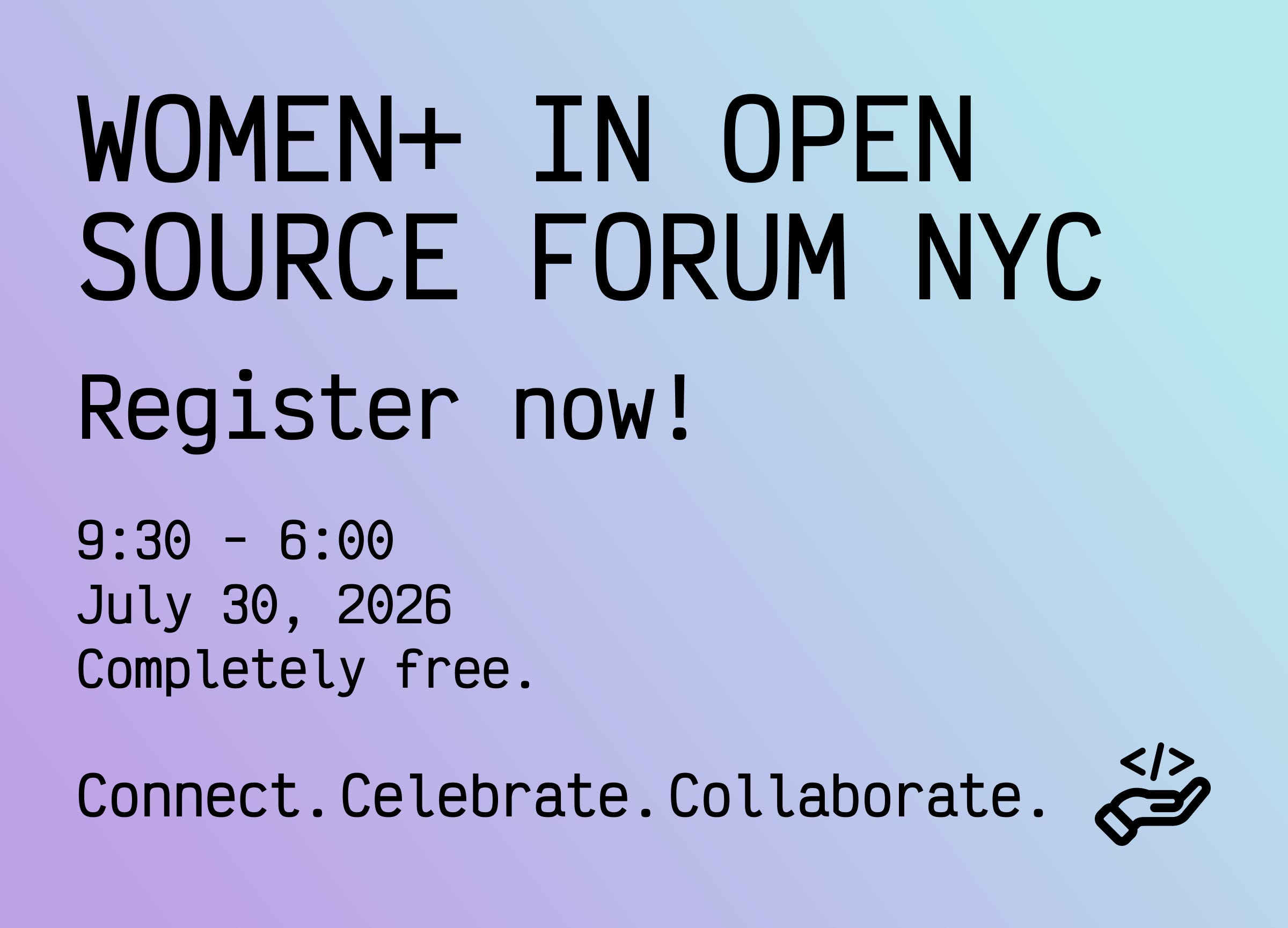
That’s what this series is becoming. We started with one event and an idea. Now we’re taking it global—in slightly different formats depending on the local community—because the appetite is clearly there.
Help us spread the word
If you know someone in the NYC area who should be there, please share this. If you’re interested in being involved as a speaker, panelist, or sponsor—reach out. We’re still building the afternoon program and would love to hear from you.
And if you’re somewhere other than NYC and want to bring a Women+ in Open Source event to your city—let’s talk. We’re already exploring opportunities to take this series to new places.
See you in New York.
If you’re interested in more writing on open source engagement, community building, and the work happening across the ecosystem—I write about it here. Subscribe to follow along.